
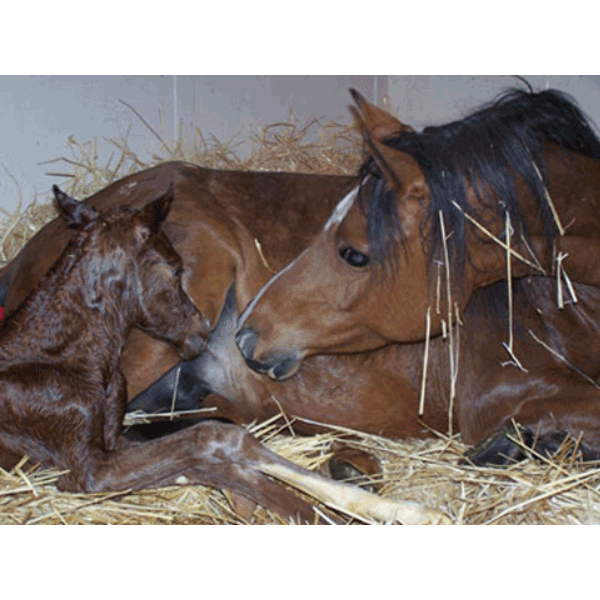
Why delay foal heat?
By Jos Mottershead
If one considers the insult that the uterus in any species receives during pregnancy, the fact that a mare is able to conceive, and then successfully maintain a pregnancy as soon as a week after foaling is incredible! The newly conceived conceptus does take between 5 and 6 days to make its way into the mare’s uterus, (fertilization takes place in the oviduct), so there is already an additional five day “break” after the mare ovulates to allow improved uterine condition, but studies have shown that the pregnancy rate in mares that ovulated more than 10 days post-partum is higher than those that ovulated before that time. The average range of naturally occurring ovulation day post-foaling falls anywhere between 5 and 15 days post-foaling (with it typically being closer to 5 days with fatter mares). In view of how rapidly the mare’s uterus can recover, a couple of extra days before ovulation can make a big difference, so obviously the answer to the question “why delay foal heat?” is to allow a little longer for the uterus to recover from foaling.
If one wishes to achieve good pregnancy rates on the foal heat, the following factors should be in place:
- The foaling must have been without any complications, such as dystocia, retained placenta, tears or abnormal bruising to the tract etc.
- There should be no obvious abnormalities of the placenta (which could suggest issues related to placentitis, and hence a pathogen in utero);
- There should be no discharge by about day 7 post foaling, or at the worst only minor clear or slightly pink discharge;
- There should be very little, or no evidence of fluid within the uterus by the time the breeding occurs (although this can be managed in most cases, but should be managed and not ignored);
- The ovulation for the breeding should occur at least 10 days after foaling
To delay the foal heat ovulation one must manipulate the mare’s hormones. I’m not going to discuss the hormonal aspect of the estrous cycle of the mare here, as that would make this article far too long, but any breeder should have a good working knowledge of it, and more information can be found in our “mares hormones” article.
The hormones most commonly used to manipulate the mare’s estrus cycle are Progesterone (or an analogue thereof – altrenogest – brand name Regumate®); Estrogen; and Prostaglandin (or a synthetic analogue thereof such as Cloprostenol). For prostaglandin to affect an estrous cycle, it requires an active Corpus Luteum (CL), the structure which forms on the ovary after an ovulation, and as the post-partum mare doesn’t have a CL (not having ovulated for a long while), this hormone cannot be used to manipulate estrus at this stage by itself. Either of the other two can however be used alone, or in combination. To successfully delay foal heat using hormonal manipulation, the treatments must commence no later than 24 hours after foaling, and preferably within the first 6 hours post-foaling. If prior to foaling you know that you intend to attempt delay, a good policy is to include the first dose of the necessary hormone in your “foaling kit”. When you go in to dip the foal’s navel with chlorhexidine, tie up the fetal membranes prior to the mare getting up, and treat the mare with a dewormer to reduce the chance of “foal heat scours”, you will then (hopefully) remember to treat the mare with the hormone at the same time.
Progesterone or Regumate® (Altrenogest)
Treatment commencing on the day of parturition, at regular dosage levels (150 mg/day intramuscularly for progesterone or 0.044 mg/kg per day orally for Regumate®) for a period of eight days, will usually result in the mare entering estrus approximately 3 days after treatment ends. Allowing for an estimated 5 days before ovulation during the estrus, this means the mare should not ovulate before 16 days post-partum. You will note that I say “should not”! As progestins alone will not necessarily suppress the mare’s own cycle, she may still produce an early follicle and ovulate. In case this does happen, it is usual to administer a dose of prostaglandin in conjunction with the last dose of progestin. (The prostaglandin will then act if there is an active CL present). There are injectable formulations of progesterone and altrenogest also available in North America through BET Pharm.
A valid argument can be made against the use of progestins immediately following foaling. Two of the natural functions of progesterone secreted by the mare (and which are mimicked by exogenous progestins) are to encourage closure of the cervix and to lower uterine immune response. Post-foaling, the mare needs a relaxed cervix in order for any residual fluid and detritus to successfully drain; additionally, the pathogenic insult that occurs during foaling is huge, so suppression of the uterine immune function at that stage could result in an increased chance of a pathogen remaining active within the uterus, and development of a full-blown uterine infection. While these issues may not occur in every instance of use, they are worthy of consideration prior to commencement of treatment.
Progesterone and Estradiol 17β combined

Long-acting P&E from BET Pharm
This combination is not currently available in any brand name product, but is available through veterinary compounding pharmacies such as BET Pharm. It is an injectable product given at the dosage level of 150mg progesterone, 10 mg estradiol 17β, per day intramuscularly. Estradiol cypionate used in this combination has not been shown to work reliably.
The estrogen will suppress the mare’s ovarian activity, and this will prevent the formation of an early follicle, making this protocol far more dependable. Treatment is for 5 days, commencing the day of parturition. The mare is unlikely to ovulate before 10 days after commencement, and most usually after the 13th day. Typically the number of days that “P&E” is given will be the number of days that the foal heat ovulation is delayed.
Estradiol cypionate
There has been evidence of success in delaying onset of first post-foaling estrus by giving 2 to 4 ml (10 mg/ml) of estradiol cypionate to the mare on day 6 post-parturition. Success depends however upon the mare not having developed an imminently ovulatory follicle or having ovulated prior to administration. An added advantage of the use of an estrogen alone (without an associated progestin) is that the cervix will not be encouraged to close, nor will there be a suppression of the uterine immune responses – in fact, if anything, cervical relaxation and uterine immune response will be enhanced.
Alternatives to delay
The above are all methods of delaying the onset of immediate post-parturition estrus. Another possibility to allow more time for the uterus to become serviceable prior to breeding, but still be breeding shortly after parturition, although not quite as early, is to allow the normal passage of one estrus, monitoring the ovulation date carefully, and then administering a dose of prostaglandin no fewer than 6 days after the ovulation. This will typically result in the mare re-entering estrus 3 to 5 days later. If prostaglandin is to be used on a mare foaling early in the year with a view to breeding her on a cycle after foal heat, it is important that the mare have been kept “under lights” for the preceding 60 or so days. Without light stimulation early foaling mares may go through a foal heat, and lapse into seasonal anestrus or transitional phase. Note that placement of a pregnant mare under lights with the intent of maintaining early cyclicity may also result in the pregnancy duration being reduced by up to 2 weeks, and that could present a problem if the mare was bred the previous year with an intended delivery date of January 1st!
Other reasons exist for the hormonal manipulation of the estrous cycle immediately post-partum. The mare who shows “lactational anestrous” – the mare who appears to not have an estrus phase while she is nursing a foal – is one. Some of these mares will show a first post-partum estrus, and then no other until weaning – we have to admit that although we know how and why to delay foal heat as well as other factors relating to improving pregnancy rates, there will always be exceptions! Other mares may not even apparently have a “foal heat”, although in most cases, these mares may be undergoing a “silent heat“, and still ovulating. With the use of careful monitoring – which can be made easier with hormonal manipulation – and artificial insemination, it is often possible to get these mares pregnant.
Note:
The use of hormones should be done only under veterinary supervision. Consult with one before commencing any of these protocols. Individual animal situations and responses vary.
The hormones used in manipulation of the mare are the same hormones that are present in humans, and they can be absorbed through the skin if spilled. All asthmatics, regardless of sex, and pregnant women must be particularly careful when handling prostaglandin. Progesterone or Regumate® must be handled extremely carefully by all women to avoid significant disruption of menstrual cycles. The wearing of nitrile gloves is recommended for all persons handling Regumate (note that latex gloves will not offer suitable protection).
© 1998 Updated 2007, 2009, 2020. Equine-Reproduction.com, LLC
Use of article permitted only upon receipt of required permission and with necessary accreditation.
Please contact us for further details of article use requirements.
Other conditions may apply.


